Sending Boards off for Fabrication
Sending Boards off for Fabrication#
I have had a busy few days and have finally got around to sending some more boards off for fabrication. This time, the boards are the RS485 non-isolated board and the revised Digital I/O Expander Board.
The RS485 board has had a few tweaks. I have reintroduced 22 ohm series resistors on the A and B lines, with associated solder jumpers so that they can be bypassed if necessary. Apart from that, the design is largely the same as the previous version, except that I have moved to smaller screw terminals than last time.
The non-isolated RS485 board is aimed at bench, cabinet, and room-scale deployments, where a simple common-ground RS485 interface is suitable. The isolated version will be aimed more at larger multi-room deployments or industrial installations, where electrical isolation is required or strongly preferred.
The Digital I/O Expander Board has been more heavily revised. After thinking through the purpose of the board again, I decided to expand the amount of I/O available. The new version now has 16 logic-level inputs and 16 logic-level outputs, all intended for 3.3 V logic-level signalling.
That should hopefully be enough for most input control applications. At the very least, this board should give me more options when I start running out of pins on a microcontroller or development board.
I may also investigate an I2C bus version of the board in future, especially if I find that some applications need more I/O than makes sense to handle through the current approach.
I also received the NUCLEO-G071RB and NUCLEO-G070RB boards that I ordered previously. These should allow me to start experimenting properly with USB-C Power Delivery and eventually work towards a USB-C PD test and negotiation board.
That project is further down the pipeline, but it is useful to have the core development boards in hand. The X-NUCLEO-DRP1M1 daughterboard should come in handy for this work, as it gives me a ready-made platform for exploring USB-C Power Delivery behaviour before designing my own board.
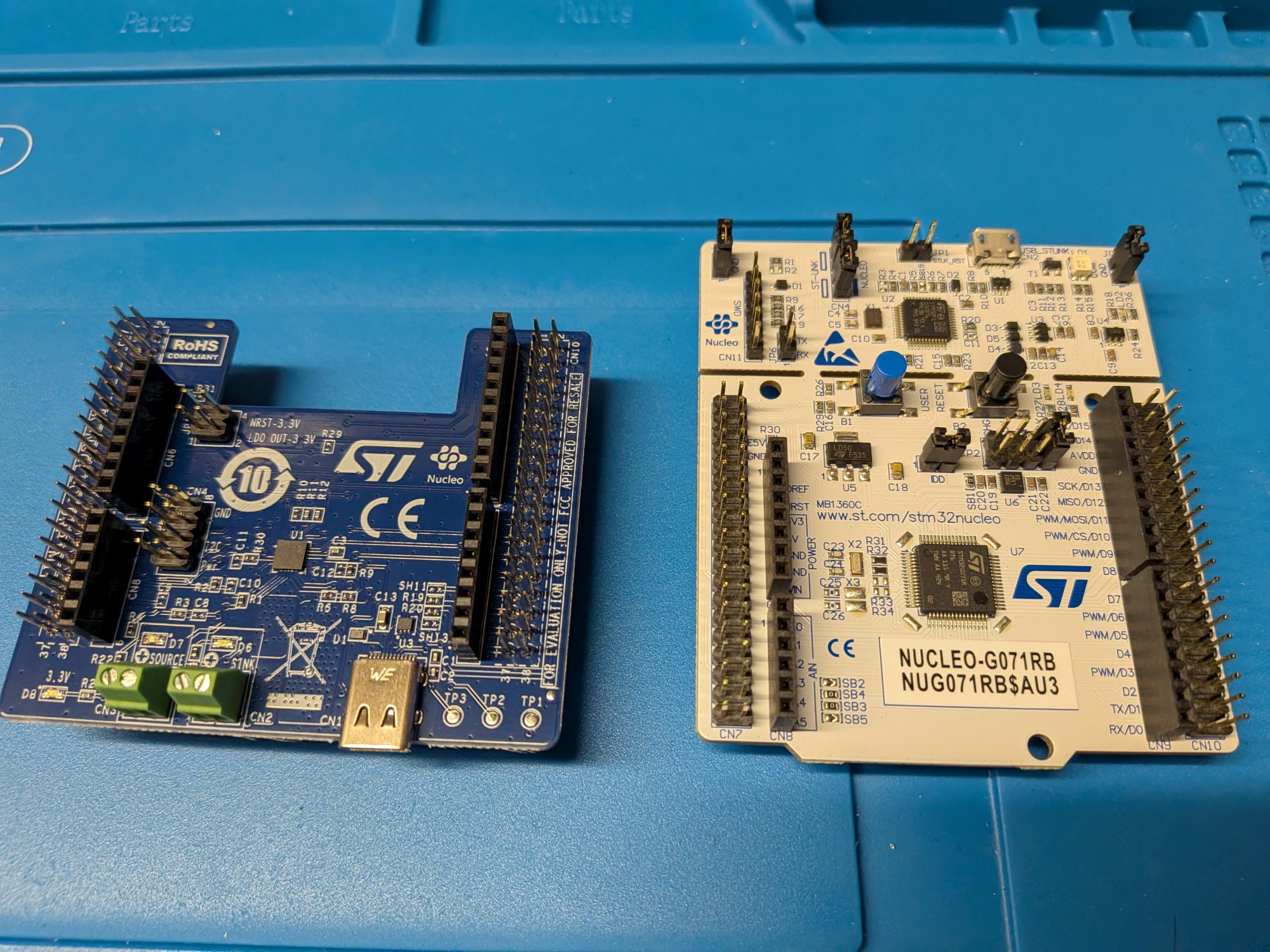
NUCLEO-G071RB and X-NUCLEO-DRP1M1
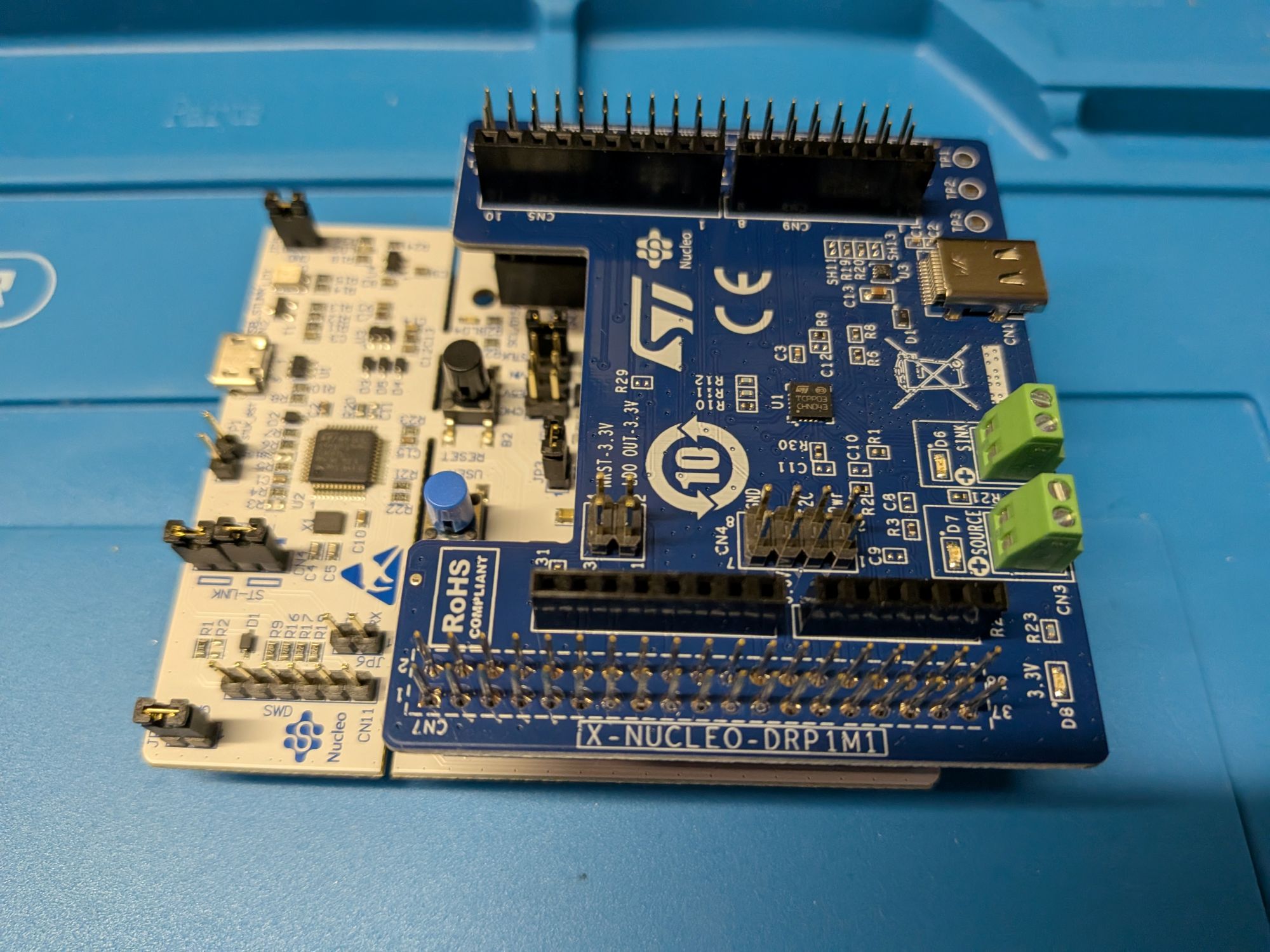
NUCLEO-G071RB with X-NUCLEO-DRP1M1 attached
I also received the NUCLEO-G070RB board so that I can investigate the capabilities of the lower-cost STM32G0 variant. It will be interesting to see where the lower-cost device is sufficient, and where the additional USB-C/PD features of the G071 make it the better fit.
For now, the main focus is getting the RS485 and Digital I/O boards fabricated, assembled, and tested. Once validated, they should become useful building blocks for control panels, industrial interfaces, test fixtures, and small embedded systems.
If you are looking for reusable open hardware modules to speed up your bench testing, or need support designing custom breakout circuits, check out our catalog at Protoworks (NI).
- 2026-10-17 Refining the Protoworks service offerings Lab
- 2026-09-27 Belfast Tech Week Lab
- 2026-09-19 Refining the UCMOD Architecture R&D
- 2026-09-06 Giving AI Agents a Way to Talk to Protoworks Software
- 2026-09-03 A Morning at a Manufacturing Trade Show Lab
- 2026-09-01 Debugging 921600 Baud on the ATtiny1614 R&D