Completing Rev A Testing of the Isolated RS485 Board
Completing Rev A Testing of the Isolated RS485 Board#
This will be a short update this time around.
Today I finished testing Rev A of the Isolated RS485 Building Block Board, concentrating on communications between two boards.
Everything worked as expected, with nothing unexpected being uncovered during testing. This was helped by the work I had already completed on the Non-Isolated RS485 Building Block Board and the test rig I assembled for it.
I will, however, hold back the KiCad project files—including the schematic and PCB layout—until I have developed Rev B. The next revision will include a redesigned input-voltage protection circuit.
Revising the Input Protection#
I have been considering replacing the current protection circuit, which uses an AO3401 P-channel MOSFET, PPTC fuse and Zener diode, with a Texas Instruments TPS25947-series eFuse. I have not yet decided on the exact variant.
The TPS25947 family provides features including:
- Input reverse-polarity protection
- Overvoltage and undervoltage protection
- Adjustable current limiting
- Reverse-current blocking
- Inrush-current control
Using an eFuse would consolidate several protection functions into a single device and provide a more controlled and robust solution than the circuit currently fitted to Rev A.
It would be slightly more expensive, but the additional protection and functionality should be worthwhile—particularly on a prototyping board that may regularly be connected to different power supplies and test setups.
The overvoltage protection on Rev A uses a relatively simple PPTC-and-Zener clamp circuit. Although it provides some protection, it is not as precise or predictable as an eFuse with a defined overvoltage threshold and controlled shutdown behaviour.
A Standalone Power-Protection Board#
I am also considering creating a standalone Building Block Board based around the eFuse.
This could provide general-purpose input protection for 3.3 V, 5 V, 9 V and 12 V systems, with the protection thresholds and current limit configured for the intended application.
Such a board would be useful for several other projects I have planned and would make a good addition to the Building Block Board range in its own right.
Rev A Is Still Useful#
Overall, Rev A is a functional board and the isolated RS485 communications work as expected. Its main weakness is the overvoltage protection circuit, which needs to be redesigned.
Until Rev B is ready, I simply need to be careful when connecting the boards and make sure that 5 V is not accidentally applied to the 3.3 V input.
The Rev A boards should still prove useful for another project I have been considering: connecting equipment in my workshop to my shed using an isolated RS485 link.
That idea is still percolating away in my brain, but I will return to it in a future article.
I will be back in a few days with more information about the changes planned for Rev B.
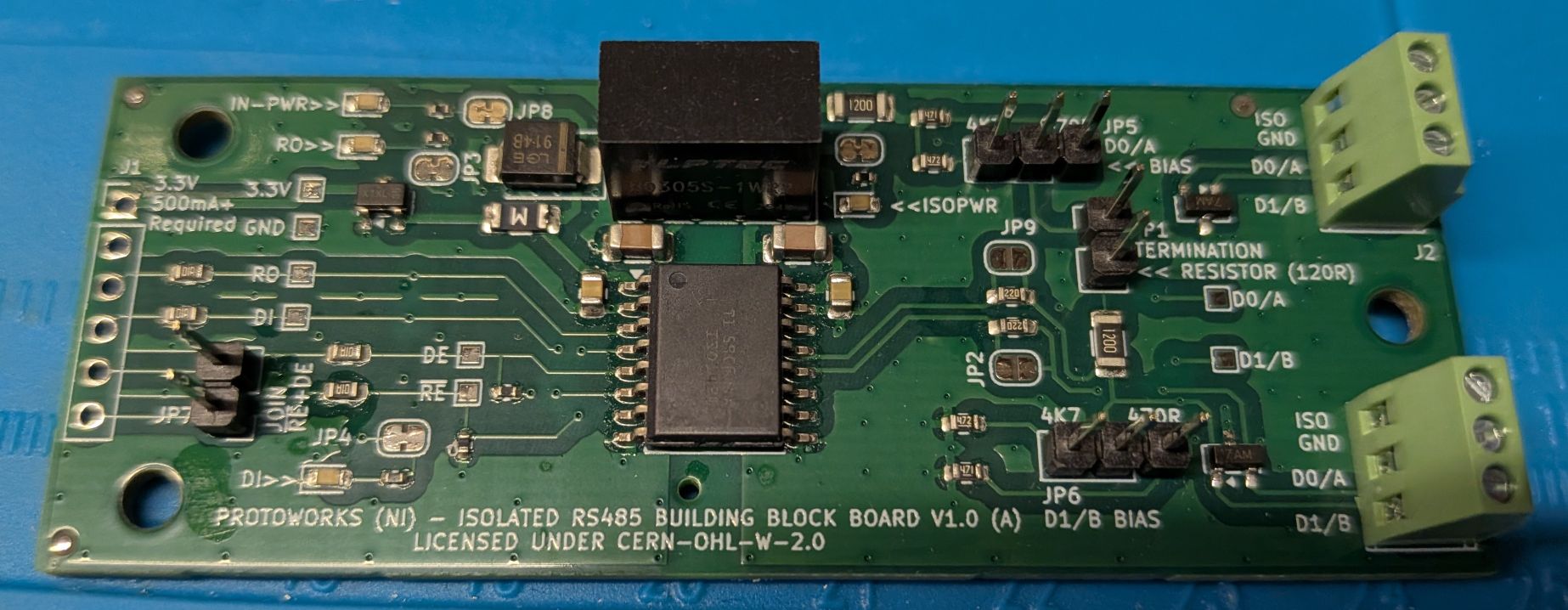
Rev A Isolated RS485 Building Block Board
- 2026-10-17 Refining the Protoworks service offerings Lab
- 2026-09-27 Belfast Tech Week Lab
- 2026-09-19 Refining the UCMOD Architecture R&D
- 2026-09-06 Giving AI Agents a Way to Talk to Protoworks Software
- 2026-09-03 A Morning at a Manufacturing Trade Show Lab
- 2026-09-01 Debugging 921600 Baud on the ATtiny1614 R&D