Refining the UCMOD architecture by defining a clearer boundary between microcontroller modules and carrier boards.
Posts for: #UCMOD
PICkit 5, GCBASIC and a Logic Green Rabbit Hole
Testing the PICkit 5 with the UCMOD-0, moving from Arduino to plain C with MPLAB, and disappearing down a couple of 8-bit microcontroller rabbit holes.
Pruning the Pipeline, Renaming UCMOD and Building an Authentication API
Pruning the Protoworks development pipeline, introducing a clearer naming scheme for UCMOD modules, and starting work on a lightweight JWT authentication API.
Defining the Small and Large UCMOD Form Factors
Further development of the STM32G0-based UCMOD-1, adding OLED and Qwiic connections while defining standard small and large UCMOD module form factors.
Defining the UCMOD Auxiliary Connector
Defining a standard auxiliary connector for UCMOD microcontroller modules, providing additional peripheral interfaces and microcontroller-specific GPIO.
Software Testing the UCMOD-0 over RS485
Software testing the ATtiny1614-based UCMOD-0, configuring its clock and brown-out detection, measuring RS485 bus voltages and sending data to a Raspberry Pi Pico.
Programming and Testing the UCMOD-0 with Arduino and UPDI
Programming and performing the first software tests on the ATtiny1614-based UCMOD-0 using Arduino, megaTinyCore and an UPDI Friend.
Maker Night and Designing the UCMOD-1
A visit to Farset Labs’ Maker Night in Belfast, followed by progress on the STM32G0-based UCMOD-1 microcontroller module.
First Hardware Tests of the UCMOD-0 and RS485 Rev C
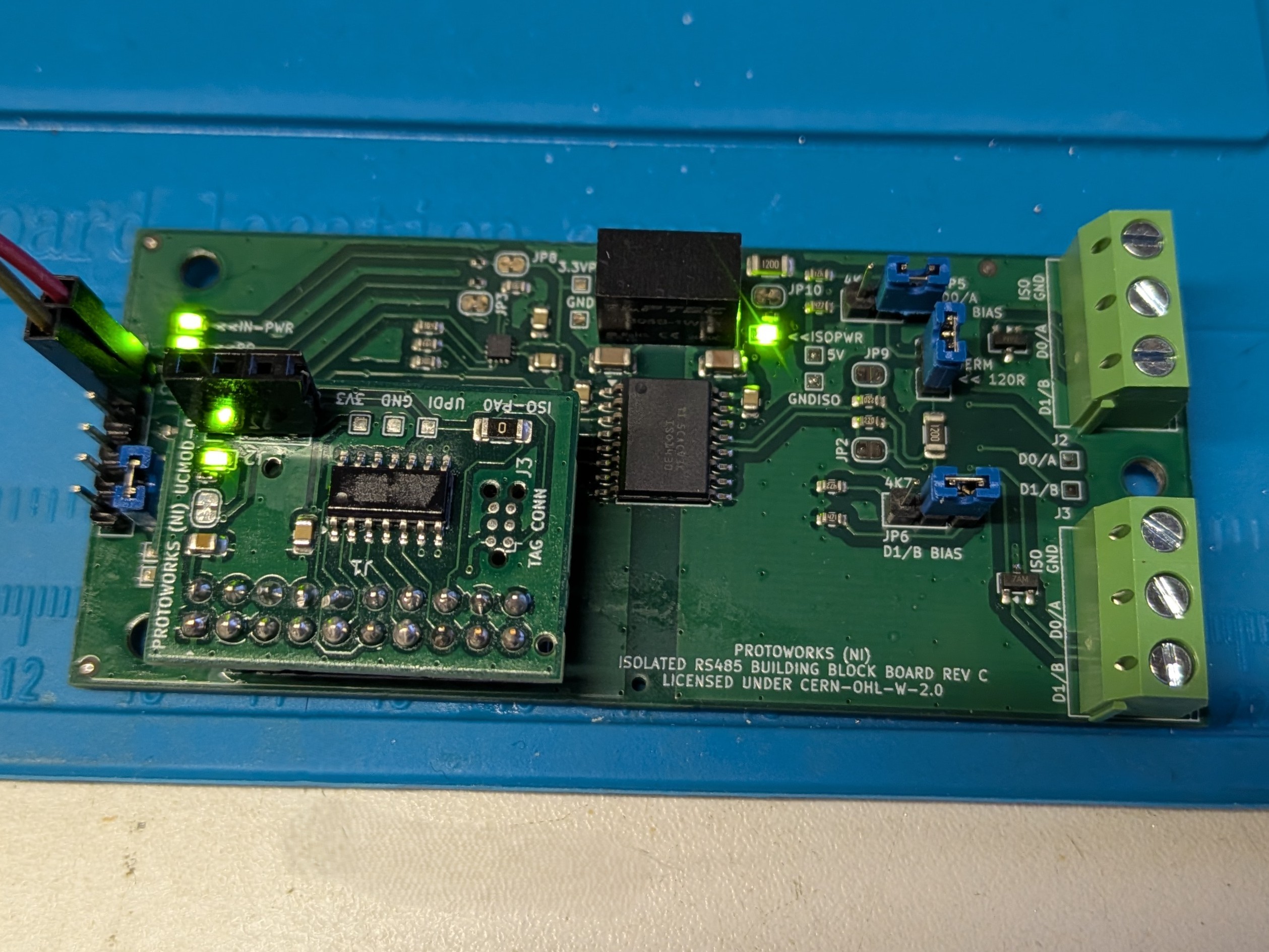
Testing the Rev C Isolated RS485 Building Block Board and the first ATtiny1614-based UCMOD-0 microcontroller module.
Tweaking the UCMOD-0 Microcontroller Module
A small revision to the ATtiny1614 UCMOD-0 module, adding UPDI power isolation and a connector layout compatible with the Adafruit UPDI Friend.
[ Page 1 of 2 ]